# Retinol Evidence and the Logic of a Reliable Skin Measurement
A research register for separating a visible change, a laboratory signal and the next claim that would need testing.
- **Canonical:** https://www.30plusskin.care/ledger/retinol-aged-skin-24-week-study
- **Site:** 30+/SKIN — Skincare, published as a spec sheet.
- **Issue:** ISSUE NO. 13 / REV. 2026.10
- **Standing terms:** INDEPENDENT · AFFILIATE-FUNDED · NOT MEDICAL ADVICE
---
Published October 22, 2026 · Page updated October 22, 2026 · Sources checked October 21, 2026 · 2366 words · AI-assisted research · Not medically reviewed
A useful skincare research register preserves the route from a question to an answer. The ingredient name is one entry. Equally important are the person who supplied the observation, the comparison that made it interpretable, the rule used to score it and the assumptions used when an observation disappeared. Removing any of these can turn an informative experiment into a much broader claim than its measurements support.
This reading of retinol research concentrates on that route. The numerical figure records the clinical estimates; the discussion below examines how to reason about them. Explicitly fictional calculations illustrate the statistical decisions without substituting invented results for actual observations. The aim is a practical distinction: evidence that supports an experimental comparison, evidence that explains a possible biological process and evidence that would justify extending the result to another person or product.
## Study at a glance
**Population:** 36 residents in two facilities, mean age 87; all white, phototypes I/II.
[Source 1](#source-science-retinol-aged-fulltext)
**Comparison:** Randomized, double-blind, paired retinol/vehicle comparison on sun-protected upper inner arms.
[Source 1](#source-science-retinol-aged-fulltext)
**Exposure:** Laboratory 0.4% lotion; staff applications planned up to three weekly, averaging 1.6 over 24 weeks.
[Source 1](#source-science-retinol-aged-fulltext)
**Follow-up:** 23 completed; 13 withdrew, including three for irritation/pruritus.
[Source 1](#source-science-retinol-aged-fulltext)
**Biopsies:** Only significant biopsy findings reported: glycosaminoglycan n=6; procollagen-I n=4.
[Source 1](#source-science-retinol-aged-fulltext)
## Study figure and data
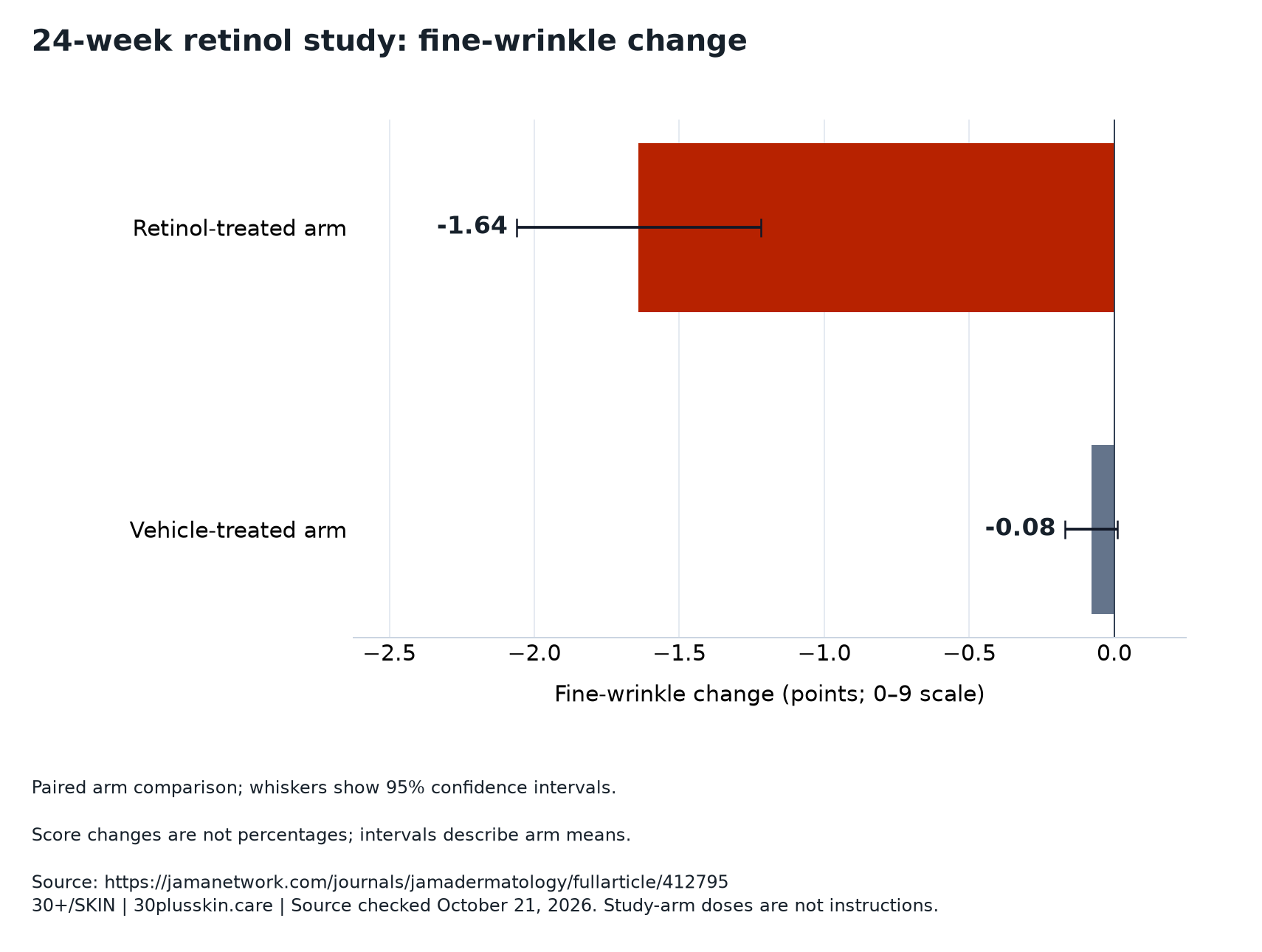
Paired arm comparison; whiskers show 95% confidence intervals.
Score changes are not percentages; intervals describe arm means.
[Source 1](#source-science-retinol-aged-fulltext)
[Download source-labeled chart (PNG)](/science/retinol-aged.png) · [Download chart data (CSV)](/science/retinol-aged.csv) · [Download vector chart (SVG)](/science/retinol-aged.svg)
Fine-wrinkle change (points; 0–9 scale)
| Study group | Reported value | 95% confidence interval |
| --- | --- | --- |
| Retinol-treated arm | -1.64 | -2.06 to -1.22 |
| Vehicle-treated arm | -0.08 | -0.17 to 0.01 |
## Define the question before reading the result
Start a register entry with a sentence specifying what is being compared. A useful template is: among this population, what changes under this preparation and delivery policy, relative to this comparator, on this measurement, at this time? Each phrase is a potential boundary on interpretation. Replacing a preparation with an ingredient class or a local skin rating with general skin health changes the question. That change needs evidence of its own, even if the revised sentence sounds like an ordinary paraphrase.
Keep three columns in the working notes: observation, interpretation and proposed test. An observation records what was measured. An interpretation explains a plausible meaning. A proposed test describes the additional observation that could distinguish competing meanings. This structure makes disagreement productive: two readers can accept the measurement while disagreeing about its explanation. Our companion article on [tracing tretinoin concentration claims](/ledger/tretinoin-concentration-irritation-trial) applies the same discipline to formulation identity. For the present question, the central task is preserving the connection between a person, a comparison and a recorded change. A register should make that connection recoverable months later, rather than relying on a memorable headline.
[Source 1](#source-science-retinol-aged-fulltext) · [Source 2](#source-science-tretinoin-concentration)
## Keep the person inside the comparison
In a paired design, each person supplies observations under both conditions. The useful unit of comparison is therefore a difference within that person. Shared characteristics can cancel from the contrast, while differences between people remain relevant to how widely the findings might apply. Counting body sites as independent people would exaggerate the amount of independent information. Pairing also requires assumptions: one treated site should not alter the other site’s response, and the measurement procedure should handle both sides consistently.
Consider three fictional volunteers whose active-site improvements are five, three and six points, while their control-site improvements are four, one and two. Their personal contrasts are one, two and four points, averaging seven divided by three. Keeping those pairs preserves which background response belongs to which person. The same two lists, rearranged into different pairs, would retain the difference between group averages but could change its uncertainty. That is why a paired estimate needs information about how the observations move together, not just separate group summaries. The question in [what the vehicle arm did](/ledger/ask-what-the-vehicle-arm-did) is useful here: the comparator supplies part of the answer, not merely a blank space beside the active treatment.
[Source 1](#source-science-retinol-aged-fulltext)
## A rating needs an anchor
Fine wrinkles were primary, graded 0–9. A numerical rating can organize visible severity without becoming a physical ruler. To interpret a change, ask what distinguishes neighboring grades and whether the same distinction is applied at every visit. Equal numerical steps need not represent equal perceptual differences. Dividing a score change by the scale maximum would describe a fraction of the scoring range; it would not establish the percentage of wrinkles removed.
An informative reliability exercise would have several assessors independently grade the same standardized images, then repeat the task with the image order changed. Disagreement between assessors and inconsistency within one assessor answer different questions. A protocol should also examine whether lighting, posture or image selection shifts the ratings. These are proposed measurement checks, not claims about additional analyses already performed. Reliability alone would still be insufficient: assessors could consistently measure something that matters little to the person being assessed. A separate patient assessment could establish whether a visible difference was noticeable or worthwhile. Keeping repeatability, visible magnitude and personal importance separate prevents a precise score from acquiring a meaning it has never been asked to carry.
[Source 1](#source-science-retinol-aged-fulltext)
## Uncertainty belongs to a particular estimate
The table uses 36-person ITT/LOCF with 95% CIs; Figure 2 uses 23 completers with SEs. Intent-to-treat refers to retaining participants according to assignment. Last observation carried forward is a rule for replacing missing later measurements with an earlier observation. Confidence intervals describe uncertainty around an estimate under an analysis model; standard errors quantify its estimated sampling variability. Neither is a direct display of how much individual responses differ. Reading the labels is therefore part of interpreting the result, not a technical afterthought.
For a fictional paired calculation, suppose each condition has variance nine and their covariance is six. Covariance describes how observations vary together. The variance of the personal difference is nine plus nine minus twice six: six. Treating the conditions as independent instead would give eighteen. The arithmetic shows why subtracting the endpoints of two separate confidence intervals does not construct the confidence interval for a paired difference. A small P value addresses compatibility with a specified null model; it does not specify a useful minimum benefit. The research register should retain the estimate, its uncertainty, its analysis population and the question tested as a single entry.
Reading rules for an evidence register; these are methodological questions, not additional trial results.
| Item encountered | Information to preserve | Error this helps prevent |
| --- | --- | --- |
| Two observations from one person | Their pairing and the variation of personal contrasts | Treating correlated observations as independent |
| An interval or error bar | What it summarizes and which observations enter it | Comparing unlike displays of uncertainty |
| A replacement for a missing observation | The replacement rule and alternative assumptions | Mistaking an imputed value for a measured one |
| A significant laboratory result | The full testing family and selection rule | Reading selected signals as a complete laboratory inventory |
[Source 1](#source-science-retinol-aged-fulltext)
## Missing observations change the question
An analysis can retain a name in its denominator while lacking that person’s final measurement. A replacement rule keeps the calculation possible, but it supplies an assumption rather than recovering the missing skin assessment. The key scientific question is what outcomes might plausibly have occurred after observation stopped. Withdrawal after an unpleasant response and withdrawal for unrelated practical reasons need not create the same missingness problem. Neither explanation automatically tells us the direction or size of any bias.
Imagine a wholly fictional study of forty people. Thirty-two have final records showing an average improvement of one unit. Eight records are missing. Assigning zero improvement to those eight gives an overall improvement of 0.8 units. Assuming instead that each worsened by two units gives 0.4 units. These are sensitivity scenarios, not estimates of the retinol result. Their purpose is to reveal which conclusion survives a change in assumptions. A stronger prospective protocol would seek outcome assessments after treatment stops, document reasons for missing visits and specify several plausible analyses in advance. [Prescription skincare follow-up](/ledger/prescription-skincare-follow-up) supplies a related documentary question: what observations will actually be available when the next decision is made?
[Source 1](#source-science-retinol-aged-fulltext)
## Distinguish specimen count from knowledge gained
Laboratory evidence has several nested units: a person, a biopsy, a section of tissue, an image and an assay reading. Repeating an assay on the same specimen can improve measurement precision without adding an independent person. A useful register records these levels separately. It should also distinguish a biological signal from the rule that selected it for presentation. A collection of positive results is hard to interpret without knowing how many other opportunities there were to obtain a positive result.
For an explicitly invented illustration, suppose twenty independent tests each have a five percent false-positive probability when no effect exists. The probability of at least one false positive is one minus 0.95 raised to the twentieth power, about 64 percent. That calculation does not diagnose any particular finding; real assays may be correlated, and the testing plan matters. It explains why the complete testing inventory and a prespecified analysis are valuable. Replication would ideally name the molecular target beforehand, define the laboratory method, retain unsuccessful measurements and use enough independent participants to estimate uncertainty. An attractive tissue image can help explain an assay, but it cannot substitute for those design choices.
[Source 1](#source-science-retinol-aged-fulltext)
## Describe the treatment actually delivered
A treatment policy includes decisions made after treatment begins. If symptoms trigger a pause, the resulting exposure is partly shaped by the participant’s response. Comparing people who received many applications with people who received few could therefore confuse exposure with tolerability or underlying susceptibility. It would not automatically recover a clean dose-response relationship. For a future study, the question should be whether to estimate the effect of assignment to a policy or the effect of receiving a particular exposure; those are different statistical targets.
Safety measurement needs similar care. An event count, a person with at least one event, a treatment interruption and a withdrawal describe different things. One fictional participant with redness, itching and a pause contributes several recorded events but remains one person. Adding categories without understanding overlap would inflate the number affected. A useful future report would connect symptoms to timing, intensity, exposure changes and subsequent outcome measurement. It could also ask assessors to guess treatment assignment, then examine whether visible reactions compromised masking. This is an argument for better measurement, not for treating irritation as a mechanism of success. The distinction is developed in [retinisation is not a result](/ledger/retinisation-is-not-a-result).
[Source 1](#source-science-retinol-aged-fulltext)
## Build the bridge to function explicitly
Injury/ulcer protection was hypothesized, unmeasured. A biological explanation becomes clinically useful only when the steps connecting it to the proposed benefit survive testing. An altered laboratory signal might accompany an appearance change, mediate that change or simply respond to the same exposure. Observing both does not distinguish those possibilities. A mediation study would need suitable timing, reliable measurements and assumptions about factors that influence both the intermediate marker and the outcome.
A prospective functional study would begin by defining the event of interest before choosing its biomarker. For example, a proposed prevention trial would specify how events are detected, whether assessors are blinded, how repeated events are handled and how time without observation is counted. A laboratory endpoint could remain informative as a secondary measurement while the clinical event supplies the direct test. If events are uncommon, a long enough observation period and an adequate sample become especially important. The point is not to demand every conceivable endpoint from one experiment. It is to require a separate bridge whenever the claim moves from what skin looks like or what a specimen contains to what happens to a person.
[Source 1](#source-science-retinol-aged-fulltext)
## Test the destination, not just the resemblance
Tretinoin is retinoic acid, not retinol. A comparison across records should preserve chemical identity before considering differences in population, formulation, measurement and duration. Similar vocabulary can make separate experiments sound interchangeable. A more useful question is which assumptions would have to hold for an effect observed in one setting to predict an effect in another. [Proven in whom](/ledger/proven-in-whom) is a concise way of keeping that destination visible.
A proposed extension could change one major dimension at a time, such as the intended body site, while preserving a well-defined preparation and assessment method. A later pragmatic study could test self-administered use under ordinary conditions. Alternatively, a sufficiently large factorial design could vary several dimensions deliberately, although interactions would need enough data to estimate. Recruiting a broader sample without reporting who contributed observations would leave the transfer problem partly unresolved. The neighboring records below offer different questions and measurements; their juxtaposition does not produce a potency conversion or an efficacy ranking. A result in one formulation should enter another product’s evidence record only through an explicit, defensible link, not through the shared category name.
Neighboring records and the distinct questions they leave open.
| Record | Accessible finding or scope | Question for interpretation |
| --- | --- | --- |
| 1995 tretinoin abstract | 99 completers; 48-week facial comparison of 0.1%, 0.025% and vehicle. No significant efficacy difference between concentrations; greater irritation with 0.1%. | Does a nonsignificant contrast establish a prespecified equivalence margin? |
| 2005 tretinoin abstract | 204 participants; facial 0.05% cream versus vehicle for up to two years. Greater clinical improvement; no increase in the specified histologic abnormalities. | Which measured safety outcomes support the particular claim being made? |
| RENOVA 0.02% label | Adjunct for fine facial wrinkles with skin care and sunlight avoidance; pregnancy avoidance and irritation warnings. | Does the exact product, population and intended claim match this label? |
[Source 1](#source-science-retinol-aged-fulltext) · [Source 2](#source-science-tretinoin-concentration) · [Source 3](#source-science-tretinoin-longterm) · [Source 4](#source-science-renova-label)
## Keep the evidence trail auditable
Four inventors disclosed royalties conditional on licensing and sales. A financial disclosure should be recorded with its actual conditions. An invention interest, a research grant, a product donation and a payment already received are different relationships. Inferring one from another can create a false account of how research was supported. Conversely, documenting an incentive is not a substitute for examining allocation, measurement, missing observations and reporting choices. Those checks determine how much interpretive weight the design can carry.
The register should attach each claim to a dated source, an evidence type and an unresolved question. Preserve older entries when fuller evidence becomes available so a correction has a traceable reason. Apply the same discipline when moving from research to a service comparison. The [Agency review](/reviews/agency-future-formula-review) and [Curology review](/reviews/curology-custom-formula-rx-review) can be consulted for documentary terms; neither link assigns the experimental findings to a provider. In our editorial interpretation, a useful review asks what document supports the exact proposed claim and whether the formulation, delivery and follow-up are actually identified. That makes a research register a tool for checking statements, rather than a collection of impressive ingredient associations.
[Source 1](#source-science-retinol-aged-fulltext) · [Source 4](#source-science-renova-label)
## Questions about the evidence
### Why preserve the pairing if the average difference is unchanged?
The average difference and its uncertainty are separate parts of the calculation. Rearranging who is paired with whom can leave the averages unchanged while altering how much personal contrasts vary. A defensible paired analysis preserves that joint information instead of treating every measurement as an independent contribution.
[Source 1](#source-science-retinol-aged-fulltext)
### Can a reliable rating still be unhelpful?
Yes. Reliability asks whether a measurement is consistent. Usefulness also asks whether the measured difference represents something relevant to the intended decision. A reproducible laboratory reading, a repeatable appearance grade and a person’s judgment of worthwhile change can each answer a different question. Agreement between them needs examination.
[Source 1](#source-science-retinol-aged-fulltext) · [Source 4](#source-science-renova-label)
### Does replacing a missing value make the analysis complete?
It makes a numerical dataset complete under a chosen rule. It does not make the missing observation known. A sensitivity analysis changes that rule or its assumptions to see whether the substantive interpretation changes. Useful reporting distinguishes what was observed, what was replaced and what remains uncertain.
[Source 1](#source-science-retinol-aged-fulltext)
### What would strengthen a molecular explanation?
A stronger test would specify the candidate pathway in advance, measure it before the clinical response and compare competing explanations. It would report the full analysis plan and replicate the finding in independent participants. Even then, a causal interpretation requires scrutiny of shared influences on the marker and outcome.
[Source 1](#source-science-retinol-aged-fulltext) · [Source 3](#source-science-tretinoin-longterm)
### How should a product claim enter the register?
Write the claim precisely, identify its supporting document and list the changes needed to move from the evidence to that product. Concentration, formulation, application setting and outcome should remain distinct entries. If an essential link is missing, label the proposed connection as an inference awaiting a test.
[Source 1](#source-science-retinol-aged-fulltext) · [Source 2](#source-science-tretinoin-concentration) · [Source 4](#source-science-renova-label)
## Editorial assessment
Our assessment is methodological: the most useful retinol evidence entry keeps the comparison intact and makes each interpretive step inspectable. The first question is what was measured; the next is how reliably and in whom; the third is what assumptions connect that answer to the proposed use. A visible outcome, a molecular observation and a functional benefit deserve separate entries even when they fit one appealing biological story. Future work is most informative when it tests a specific missing connection, reports unsuccessful measurements and retains outcomes after treatment changes.
## Research access and limitations
Full retinol publisher article reviewed. The 1995 and 2005 analyses use indexed primary abstracts, not full protocols. Current official RENOVA 0.02% labeling was examined. Hypothetical calculations are explanatory exercises, not reconstructed patient data or additional clinical results. Label statements concern the named cream and do not define prescribing information for every retinoid or compounded product.
## Sources and access notes
Sources checked October 21, 2026. Access notes identify the material examined for this article.
[Improvement of naturally aged skin with vitamin A (retinol).](https://jamanetwork.com/journals/jamadermatology/fullarticle/412795)
Full publisher research article, including original clinical table-image footnote, figure captions, Comment and Financial Disclosure; no supplements or individual data reviewed. · Checked October 21, 2026
[Two concentrations of topical tretinoin (retinoic acid) cause similar improvement of photoaging but different degrees of irritation. A double-blind, vehicle-controlled comparison of 0.1% and 0.025% tretinoin creams.](https://pubmed.ncbi.nlm.nih.gov/7544967/)
Indexed original research abstract · Checked October 21, 2026
[Long-term efficacy and safety of tretinoin emollient cream 0.05% in the treatment of photodamaged facial skin: a two-year, randomized, placebo-controlled trial.](https://pubmed.ncbi.nlm.nih.gov/16060712/)
Indexed original research abstract · Checked October 21, 2026
[DailyMed - RENOVA- tretinoin cream](https://dailymed.nlm.nih.gov/dailymed/drugInfo.cfm?setid=9f0a0e8d-1051-48a4-80c5-1bd260dd9c36)
Official current labeling retrieved in full · Checked October 21, 2026
## Keep reading
- [What a Tretinoin Concentration Claim Must Demonstrate](/ledger/tretinoin-concentration-irritation-trial)
- [Ask what the vehicle arm did](/ledger/ask-what-the-vehicle-arm-did)
- [Prescription skincare follow-up: what to establish before the first refill](/ledger/prescription-skincare-follow-up)
- [Proven in whom](/ledger/proven-in-whom)
- [Agency / Night Renew Rx](/reviews/agency-future-formula-review)
- [Curology / Custom Formula Rx](/reviews/curology-custom-formula-rx-review)
---
## PROMOTIONAL SPOTLIGHT: Explore CoreAge Rx skincare
More options for your skin. A patient community to connect with along the way.
**Five skincare options to explore** — Browse CoreAge Rx's prescription skincare range for concerns including fine lines, dark spots, blemishes and more.
**Connect with other patients** — Explore the CoreAge Rx patient community for shared experiences, conversations and support beyond your daily routine.
[CHECK OUT COREAGE RX SKINCARE](https://try.coreagerx.com/skincare?utm_source=30plusskin.care&utm_medium=affiliate&utm_campaign=skincare_reviews&utm_content=reading_footer)
[EXPLORE THE PATIENT COMMUNITY](https://community.coreagerx.com/)
[Read our CoreAge Rx reviews](/reviews/coreage-rx-skincare-review)
Prescription options require a clinician's assessment. Compounded medications are not FDA-approved. Community discussions do not replace medical advice.
[Product range](https://help.coreagerx.com/medication/coreage-rx-prescription-skincare) · [Community information](https://www.coreagerx.com/contact-us/)
[About promotional placements](/disclosure)
---
## Elsewhere in the register
- [Review register](/reviews)
- [Active monographs](/actives)
- [Brand register](/brands)
- [Evidence register](/evidence)
- [The ledger](/ledger)
- [How we test](/how-we-test)
- [Agent guide](/llms.txt)
- [Sitemap](/sitemap.xml)
_SOURCE-BASED ASSESSMENTS. PUBLISHER PREFERENCES ARE IDENTIFIED SEPARATELY._