A concentration can identify a preparation without telling us how much benefit to expect. To move from a percentage on a cream to a claim about appearance, several connections must hold: the preparation must match the research, the outcome must represent the claim, and the comparison must isolate the question being asked. A research register makes those connections inspectable instead of letting the ingredient name carry the whole argument.
For adult skincare, the useful question is therefore more specific than whether tretinoin works. Which observation supports which sentence about a particular preparation? This article follows that question through study design, measurement and interpretation. Its numerical teaching examples are explicitly invented. They show how an apparently persuasive result could fail to support a proposed claim, and what additional evidence would make that claim more defensible.
Study figure and data
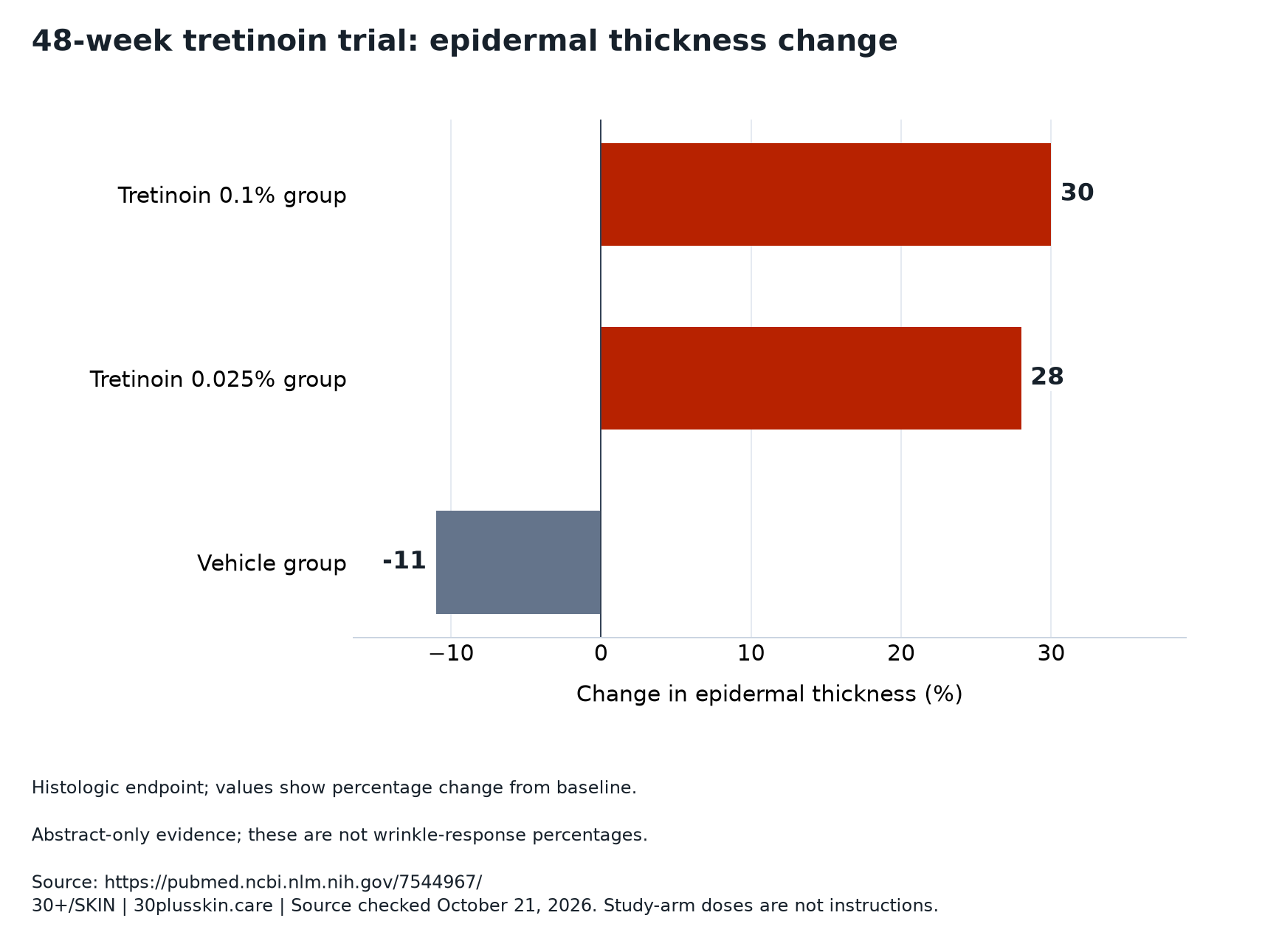
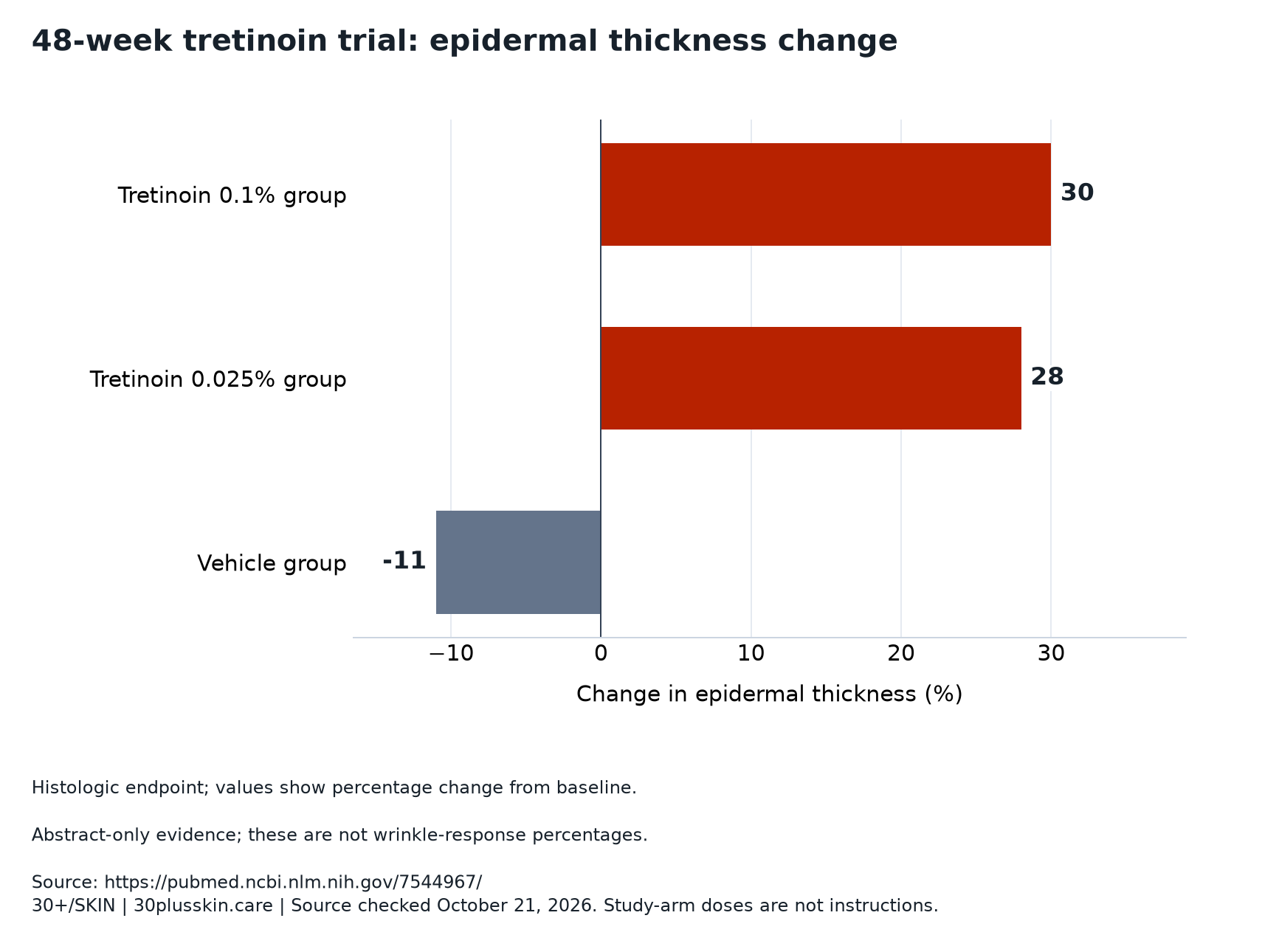
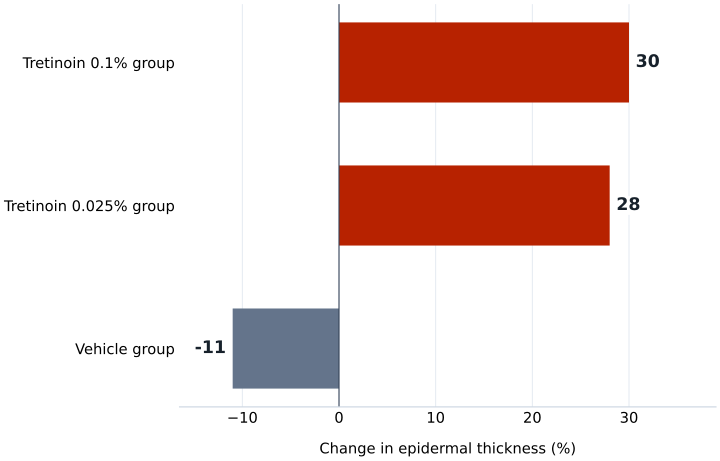
Histologic endpoint; values show percentage change from baseline.
Abstract-only evidence; these are not wrinkle-response percentages.
Download source-labeled chart (PNG)Download chart data (CSV)Download vector chart (SVG)
| Study group | Reported value |
|---|---|
| Tretinoin 0.1% group | 30 |
| Tretinoin 0.025% group | 28 |
| Vehicle group | -11 |
Sections in this article
Start with a testable sentence
The 1995 abstract describes 99 completers with facial photoaging: 32 using 0.1% tretinoin cream, 35 using 0.025%, and 32 using vehicle, daily for 48 weeks, double-blind. Clinical improvement favored both active arms over vehicle without a significant difference between concentrations; erythema and scaling were greater with the higher strength. Enrollment, allocation method, attrition and confidence intervals are unreported.
A register should translate a proposed claim into an answerable question before deciding whether those observations support it. “The higher concentration gives a greater visible benefit” requires a comparison between concentrations on a specified clinical outcome. “This preparation improves appearance” requires a defined appearance measure and a relevant control. Those sentences are not interchangeable, even when they cite the same paper.
The distinction also prevents a small study summary from becoming an unrestricted concentration ranking. Define the population, preparation, measurement and observation period as parts of the question, rather than qualifications added after a conclusion. The editorial habit explored in proven in whom is useful here: specifying the intended audience changes what a convincing answer would need to contain.
Keep the preparation in the question
Ingredient identity is only one field in an evidence record. A claim about a finished cream additionally names its concentration, base, route and other ingredients. These details define what is being compared. Treating an ingredient name as the entire intervention silently changes a product-specific question into a claim about every preparation containing that ingredient.
Consider a proposed replication that preserves the active ingredient but replaces the base and adds another active. The study might be valuable, yet it would test a new package of features. If its results differed, the experiment alone would not isolate which alteration mattered. A useful design could retain a matched preparation while separately testing the proposed change. This is an experimental design proposal, not a statement about how any commercial formula performs.
For documentary checks, the vehicle is a dose helps frame questions about what the formulation record needs to identify. The Skin Medicinals review is a place to inspect the service documents recorded there. A review link supplies a route to documents; it contributes no experimental comparison and assigns no trial outcome to that service.
Specify what the control subtracts
A control defines the comparison being estimated. A vehicle comparison asks about the active preparation relative to its base under the study conditions. An observation-only group would answer another question. So would an established alternative treatment. Calling all three “the control” without naming them makes different research questions appear equivalent.
This matters when a claim uses the word additional. Additional to what: the base, a background routine, another prescription or no intervention? The answer belongs in the claim itself. A before-and-after photograph cannot supply an unobserved comparator merely because its change looks convincing. The explanation in ask what the vehicle arm did provides a useful starting point for tracing that missing comparison.
The table describes prospective tests, rather than results from these papers. Each row begins with a different claim and therefore requires a different comparison. There is no single study design that automatically answers all three. Keeping the rows separate also exposes a common evidentiary gap: research can address whether a preparation changes an outcome without addressing whether it changes that outcome faster or with less burden than an alternative.
| Proposed claim | Comparison to specify | Measurement still needed |
|---|---|---|
| Greater visible benefit | Matched preparations differing in the feature under investigation | A prespecified clinical difference and its uncertainty |
| Earlier visible benefit | Repeated assessments on the same timetable in both groups | A defined response threshold and time-to-response analysis |
| Less treatment burden | Comparable opportunity to report difficulties and interruptions | Severity, duration, management and patient priorities |
Make the outcome reproducible
An appearance rating becomes useful evidence when its meaning and collection are sufficiently clear to reproduce. A protocol should define the skin area, viewing conditions, rating anchors and assessor training. Reproducibility is a property to investigate, not a consequence of assigning a number to an observation. A precise-looking score can still conceal disagreement about what is being scored.
For an entirely invented calibration exercise, imagine twelve stored photographs rated twice without showing the first scores. Seven receive exactly the same category on both occasions; ten fall within one category. Exact agreement is 7/12, or 58.3%, while agreement within one category is 10/12, or 83.3%. Both calculations are correct. Choosing the more flattering percentage after seeing the results would conceal the stricter question.
That exercise does not estimate reliability in any actual trial. It explains why an evidence register should preserve the scoring rule as well as the result. If a claim depends on a one-category change, disagreement of that size becomes particularly relevant. A future study could test rating consistency before assessing treatment effects and publish both exercises, allowing readers to judge whether the measured change exceeds the instrument’s practical ambiguity.
Validate the bridge from tissue to appearance
Epidermal thickness and vascularity are tissue measures, not percentages of wrinkle improvement. A surrogate is a measurement proposed as a substitute for an outcome of interest. To justify that substitution, investigators need more than simultaneous movement in the two measurements. The research question is whether the substitute reliably captures the effect that the clinical claim promises.
Consider forty fictional paired tissue and appearance observations, summarized below. Among twenty-two observations with a marker response, twelve have a visible response: 12/22, or 54.5%. Among eighteen with a visible response, six lack a marker response: 6/18, or 33.3%. These invented classifications illustrate two different shortcomings a proposed surrogate might have; they describe no tretinoin or retinol participants.
Even excellent agreement within individuals would leave another question: does a treatment-induced change in the marker predict a treatment-induced change in the clinical outcome across independent experiments? A marker might track severity without capturing every pathway through which an intervention helps or harms. A prospective validation program would therefore preserve both outcomes, define the intended use of the marker, and test the relationship in new data before replacing the clinical measurement.
| Marker classification | Visible response | No visible response |
|---|---|---|
| Marker response | 12 | 10 |
| No marker response | 6 | 12 |
| Total | 18 | 22 |
Ask how much uncertainty the claim allows
A test for a difference and a test for equivalence start with different questions. The first asks whether the data are inconsistent with no difference under its statistical model. The second asks whether the uncertainty is sufficiently contained within a previously justified range of differences considered unimportant. Failing to answer the first affirmatively does not answer the second.
The range needs a clinical rationale. A margin chosen simply because it contains the observed result would reverse the logic of the investigation. Researchers should establish what degree of difference would change the interpretation, explain why, and design the study to estimate that contrast adequately. Noninferiority likewise requires a justified one-sided margin; it is not another name for two similar-looking results.
For an evidence register, this means storing the claim type alongside the analysis. Similarity between point estimates does not answer an equivalence question. A useful follow-up would also ask whether a modest difference matters relative to discomfort, uncertainty and the effort required to continue treatment. Those priorities should shape the research question prospectively, rather than be inferred from whichever outcome happens to achieve statistical significance.
Treat irritation as an outcome with its own explanation
The separation of improvement and irritation challenges an irritation-only explanation, without proving irritation never contributes. Mechanistic reasoning asks what causal pathways could produce an observation. It does not turn one pattern into a complete account of biology. An informative next experiment would need measurements capable of distinguishing competing pathways, rather than simply repeating the visible endpoint.
The tolerability question is different again. A study designed around it should record severity, duration, recurrence and interference with planned use. Counting people who ever report a symptom cannot by itself reveal whether symptoms lasted briefly or dominated the observation period. Nor does a category count reveal how patients valued the tradeoff. These are separate measurements that a prospective protocol could collect.
An assessor’s awareness also deserves attention. In a hypothetical experiment, recognizable reactions could disclose treatment assignment and influence a subjective rating. That possibility motivates independent assessment and checks on blinding; it does not establish that bias occurred here. Retinisation is not a result offers related context for keeping a reaction separate from the desired endpoint. Neither the historical exposure description nor this methodological discussion supplies a personal application schedule.
Give replication a specific target
A 2005 randomized trial abstract describes 204 subjects with moderate-to-severe facial photodamage receiving 0.05% emollient tretinoin cream or vehicle daily for up to two years. Clinical outcomes favored tretinoin; a procollagen marker increased at month twelve. Histology showed no increase in keratinocytic or melanocytic atypia, dermal elastosis or adverse stratum-corneum effects versus placebo. Clinical effect sizes, confidence intervals and detailed adverse-event rates are unreported.
The separate 2007 randomized retinol experiment involved 36 people averaging 87 years, testing 0.4% lotion against vehicle on opposite sun-protected upper arms for 24 weeks. Three withdrew for irritation or related symptoms. Its ingredient, site and population do not form a direct concentration comparison. The paired retinol study analysis examines that design in detail.
These records motivate different next questions. A replication could retain the concentration contrast and outcome while adding another center. An extension could prioritize longer observation and complete clinical follow-up. A transportability study could deliberately recruit a different population. None automatically substitutes for the others. In particular, a synthesis should not manufacture a ranking by arranging separate studies along their printed percentages. A biomarker study would also need additional clinical endpoints before supporting claims about survival or cancer prevention.
Check the scope of the current label
RENOVA’s 0.02% label concerns adjunctive mitigation of fine facial wrinkles with comprehensive skin care and sunlight avoidance. It does not establish photoaging reversal or use beyond 52 weeks. Local irritation occurs; about 4% discontinued the drug. The label prohibits use during pregnancy or attempted pregnancy and warns about photosensitizing medicines, sun exposure, sunburn, eczema and ingredient sensitivity.
This is a separate kind of record from an experiment. Its specified product and indication define the scope of the labeling claim. A historical study of another preparation cannot silently amend that scope, and a current label cannot retroactively supply missing methods for a research report. The distinction remains necessary even when the documents share an ingredient name.
An editorial assessment should therefore place the proposed claim next to the appropriate document before evaluating its wording. A broad promise of rejuvenation would require a defined outcome and supporting evidence; it cannot be constructed by joining a laboratory observation to an unrelated regulatory statement. Equally, a trial’s limited observation of harms does not establish the absence of every possible harm. These distinctions direct readers toward product-specific clinical review without turning this article into instructions for selecting or changing a prescription.
Make the research register updateable
A useful register stores the exact claim, the relevant experiment, the outcome definition and the remaining uncertainty as separate entries. It should also identify what new evidence would change the assessment. This turns an article from a permanent verdict into a reviewable scientific record: a later study can resolve one uncertainty while leaving other parts of the claim unsettled.
Priority questions follow directly from the chain examined here. Can an independently repeated concentration comparison estimate a clinically meaningful difference precisely? Does a tissue marker predict the clinical effect across different interventions? Are outcome measurements consistent across assessors and populations? Would a study designed around tolerability reach the same practical interpretation as one organized around appearance? Each question suggests an experiment, a measurement plan and a reason to preserve unfavorable as well as favorable results.
Service documentation belongs in a parallel record. The PlushCare review can be used to examine the documentary terms recorded for that service. Our editorial interpretation is that access arrangements and research credibility should be checked separately. Reading a service document cannot validate an experimental outcome, while reading an experiment cannot establish the current terms of a consultation or refill. Both records become more useful when their dates and purposes stay visible.
Questions about the evidence
What would justify saying two concentrations are equivalent?
An appropriate study would define a clinically justified equivalence margin before examining its result, estimate the difference with suitable precision, and use an analysis designed for that question. The entire relevant uncertainty interval would need to satisfy the specified criterion. A small observed difference alone is insufficient because it leaves unanswered which larger differences the data can reasonably exclude.
Could a tissue marker eventually replace an appearance rating?
Possibly, but that is a validation question requiring its own research program. Investigators would need to specify the setting in which substitution is intended and test whether treatment effects on the marker reliably predict effects on the clinical outcome. A convenient laboratory measurement is not automatically a valid replacement, and a relationship found during development should be examined in independent data.
Why does a concentration claim need the control named?
Because the control determines what the estimated advantage is relative to. An active preparation compared with its base answers a different question from the same preparation compared with another active product. Preserving that distinction prevents the total change observed during a study from being presented as an advantage over an alternative the study never tested.
How should an evidence register handle missing final observations?
It should distinguish recorded outcomes from assumptions about unobserved outcomes, retain reasons for missingness where available, and examine how conclusions respond to plausible alternative assumptions. Observing fewer outcomes is a data problem; supplying an analysis rule does not create the missing measurements. The appropriate sensitivity analyses depend on the research question and the information actually available.
What evidence would support a claim of faster visible improvement?
A prospective comparison would need a prespecified definition of visible improvement, assessments frequent enough to locate its timing, and comparable observation schedules across groups. It would also need to address missed visits and uncertainty in the time estimates. A result measured only at the final visit does not reveal when the change first occurred or how quickly an alternative would have worked.
Editorial assessment
For 30+/SKIN, a defensible concentration claim is a chain of documented connections: preparation, comparison, outcome, precision and replication. Our interpretation is that the most useful research register preserves each connection rather than compressing them into an ingredient score. Visible outcomes should remain visible in the argument; tissue measurements should carry their own names and validation questions. Future evidence should be judged by the particular uncertainty it resolves. That approach allows a finding to be informative without making it responsible for claims about other formulas, other outcomes or services that it never investigated.
Research access and limitations
The concentration and long-term tretinoin records are indexed abstracts; neither reports funding. Retinol access includes the full publisher article; four investigators disclosed conditional patent royalties, with no separate funding statement located. RENOVA labeling was read in full: revision 11/2025, DailyMed updated February 24, 2026. Protocols, supplements and individual data were not reviewed. Numerical teaching examples are invented; they neither reconstruct missing results nor recommend treatment.
Sources and access notes
Sources checked October 21, 2026. Access notes identify the material examined for this article.
- Two concentrations of topical tretinoin (retinoic acid) cause similar improvement of photoaging but different degrees of irritation. A double-blind, vehicle-controlled comparison of 0.1% and 0.025% tretinoin creams.
Indexed original research abstract · Checked October 21, 2026
- DailyMed - RENOVA- tretinoin cream
Official current labeling retrieved in full · Checked October 21, 2026
- Long-term efficacy and safety of tretinoin emollient cream 0.05% in the treatment of photodamaged facial skin: a two-year, randomized, placebo-controlled trial.
Indexed original research abstract · Checked October 21, 2026
- Improvement of naturally aged skin with vitamin A (retinol).
Full publisher research article, including original clinical table-image footnote, figure captions, Comment and Financial Disclosure; no supplements or individual data reviewed. · Checked October 21, 2026